Interview, Explained
In-depth breakdowns of tech interviews — section-by-section analysis with diagrams, quotes, and insights.
 ~40 min
Avsec & Gayoso on the 98% of DNA we called junk
DeepMind's AlphaGenome reads the 98% of DNA once called junk, and AlphaGenome 2 now resolves it cell type by cell type, to rank which single mutations drive disease, from a rare-epilepsy case to a gene regulated 290,000 bases away.
 ~91 min
Keerthana Gopalakrishnan on why robotics is still in its GPT-2 era
Google DeepMind's Gemini Robotics lead says the viral running robots miss the point: robotics is still in its GPT-2 era, held back by contact, cross-embodiment, and errors that compound across a task, and she treats progress as an empirical question, not a prediction.
 ~38 min
Pushmeet Kohli & Jeremy Ratcliffe on watermarking proteins, function intact
Google DeepMind's SynthID hides a key-driven signal inside AI output — text, images, and, as a proof of concept, AI-designed proteins — so its AI origin can be detected by anyone holding the key.
 ~45 min
Zoubin Ghahramani on why AI must know when it doesn't know
Zoubin Ghahramani argues that intelligence means making decisions under uncertainty: today's models can sound confident without explicitly representing belief, and calibrated uncertainty -- not scale alone -- may be one of the missing pieces.
 ~57 min
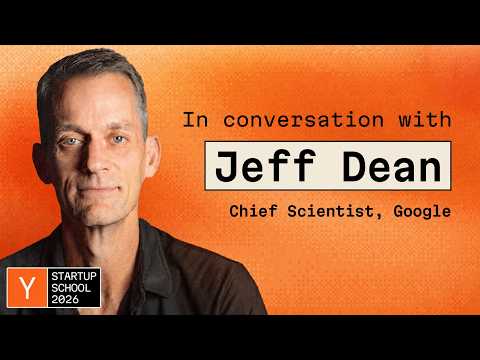
Jeff Dean on why inference hardware is AI's next bottleneck
At Y Combinator's Startup School 2026, Jeff Dean argues that as models commoditize the writing of code, the leverage moves down to the systems layer — specialized low-latency inference hardware and the energy cost of moving data — and up to the human skill of taste in choosing what to build.
 ~53 min
Neel Nanda on why AI is grown, not designed
Neel Nanda, who leads language-model interpretability at Google DeepMind, explains that modern AI is grown rather than designed, and that reading its mind takes a growing toolkit of cheap, imperfect techniques — no single one a silver bullet.